Temper Reference
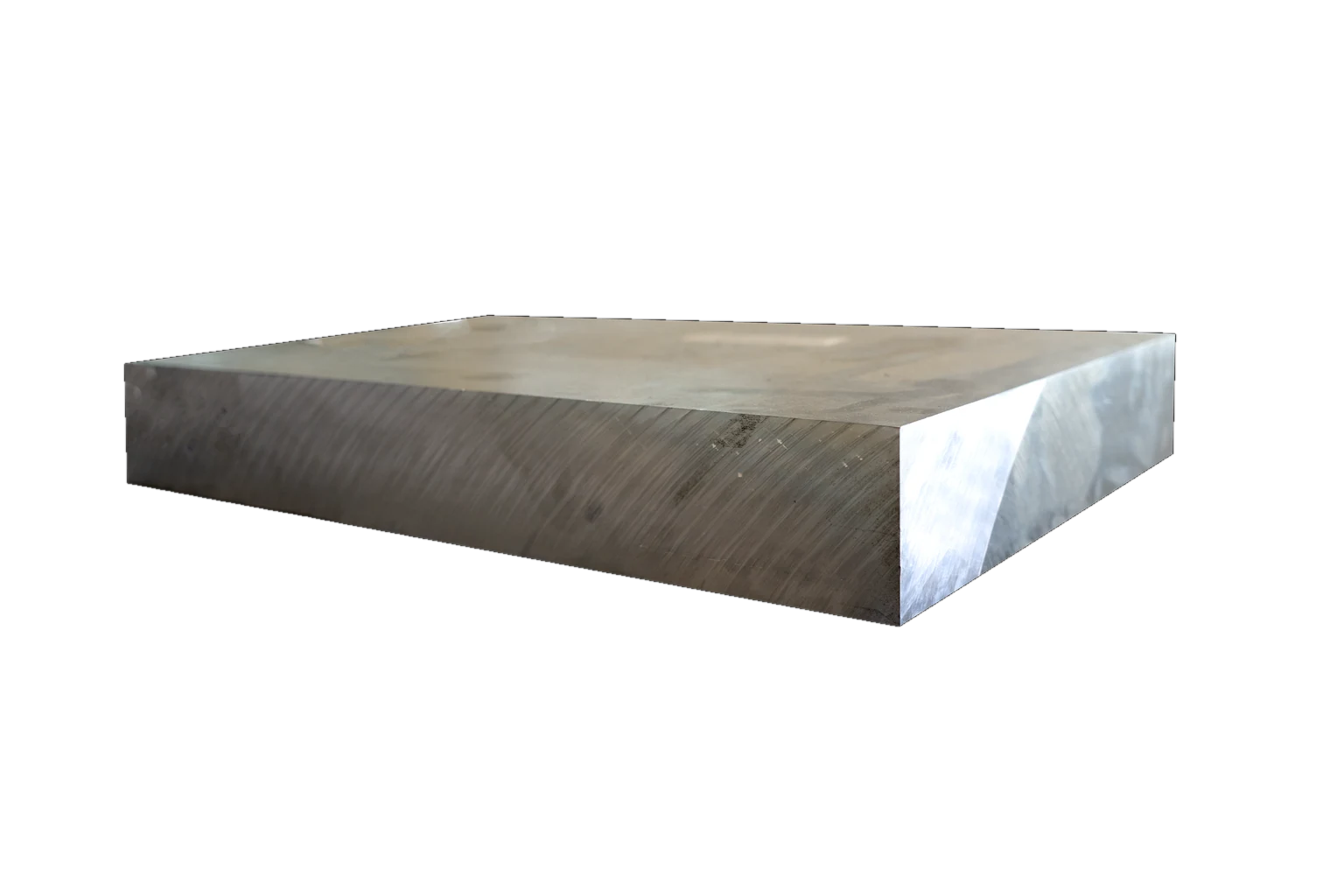
The thick-section aerospace plate standard. Solution heat treated, stress-relief stretched, and overaged to the T73 corrosion resistance level. Specified to AMS 4050 across large aircraft structural programs for its consistent properties and superior stress corrosion cracking resistance.
What is 7050-T7451?
7050-T7451 is the standard plate temper for 7050 aluminum and the primary specification for thick-section aerospace structural plate. The overaged T74 condition combined with a stress-relief stretch produces plate that resists stress corrosion cracking even in sections above 3 inches thick, where 7075-T651 would show both reduced core properties and higher SCC susceptibility. NOX METALS stocks 7050-T7451 plate from 0.25 inch through 6 inches thick, certified to AMS 4050, with mill certifications, heat numbers, and lot traceability on every order.
STEP 1
Plate is heated to approximately 895°F (479°C) to dissolve MgZn2 and other precipitates into solid solution. The zirconium addition in 7050 creates Al3Zr dispersoids that refine grain structure and resist quench rate sensitivity.
STEP 2
The quenched plate is stretched 1.5 to 3 percent of its length to redistribute quench-induced residual stress. Essential for machined aerospace components where dimensional stability through heavy material removal is critical.
STEP 3
Plate is aged in two stages to the T7451 condition, typically 8 hours at 250°F (121°C) followed by 14 to 18 hours at 325°F (163°C). The overaging reduces peak tensile strength by about 5 percent versus T651-equivalent but produces superior SCC resistance across full thickness range.
The zirconium addition in 7050 chemistry is what makes the alloy less quench-sensitive than 7075, which is what makes the T7451 condition possible at thick section without unacceptable property loss. The overaging does cost some peak strength relative to 7075-T651, but the thick-section consistency and SCC resistance are why programs specify AMS 4050.
Values are AMS 4050 specification minimums for plate in the 0.25 to 4 inch thickness range. Properties remain within a few thousand psi of these values up to 6 inches due to the reduced quench sensitivity of 7050 chemistry. Consult AMS 4050 for complete thickness-dependent property data.
NOX METALS mill certifications list all applicable specifications plus heat treatment records, chemistry, and mechanical test values per heat and lot. DFARS-compliant, domestic-origin, and any-origin material available for all aerospace and defense contract types.
Specify 7050-T7451 when the program specification calls out AMS 4050 directly, when the finished part is a thick-section aerospace structural component above 3 inches, when stress corrosion cracking is a formal design requirement, or when the part will see sustained short-transverse tensile load in a corrosive environment.
Aircraft wing center sections, heavy fuselage frames, landing gear bulkheads, wing skins, and similar thick-section primary structure typically specify 7050-T7451 over 7075 tempers because the thick-section property consistency matters more than the few percent peak strength advantage 7075-T651 offers in thin plate.
For thin-section parts where 7075-T651 meets the requirements, T7451 adds cost without engineering benefit. For applications that need welding, moderate strength, or lower cost, stay with 6061-T651. The T7451 premium is only justified when its specific capabilities map to the design requirements.
T7451 means the plate was solution heat treated, stress-relief stretched 1.5 to 3 percent, then overaged using a two-step schedule to achieve the T73-equivalent corrosion resistance level. The 74 indicates overaging to an intermediate level between T7351 and T76; the 51 indicates the stress-relief stretch. The combination produces a plate that is stress-relieved for machining, maintains high strength, and has excellent resistance to stress corrosion cracking even in thick sections.
7050 was developed in the 1970s by Alcoa to solve a specific limitation of 7075 in thick plate. When thick 7075 plate is quenched during solution heat treatment, the interior cools more slowly than the surface. This leaves the plate core with reduced mechanical properties and greater susceptibility to stress corrosion cracking. 7050's chemistry — specifically the addition of zirconium and adjustment of the copper-to-zinc ratio — produces an alloy far less sensitive to quench rate, maintaining consistent properties and SCC resistance across sections above 3 inches thick.
AMS 4050 is the aerospace material specification for 7050-T7451 plate covering thicknesses from 0.25 inch to 6 inches. It defines chemistry, heat treatment, mechanical properties, and qualification requirements for aerospace structural plate. When a drawing calls out AMS 4050, it specifically requires 7050-T7451 supplied to that specification with mill certifications. NOX METALS supplies 7050-T7451 plate certified to AMS 4050 with full documentation on every order.
In thin sections (below 2 inches), 7075-T651 has slightly higher peak tensile strength at 73,000 psi compared to 7050-T7451 at 72,000 psi. In thick sections (3 to 6 inches), 7050-T7451 maintains its rated properties consistently while 7075-T651 shows measurable property degradation in the section core. 7050-T7451 also has substantially better SCC resistance in the short-transverse direction at any thickness. For thick-section aerospace plate, 7050-T7451 is the standard answer.
No. 7050-T7451 is not recommended for structural arc welding. Like 7075, it is susceptible to hot cracking and substantial strength loss in the heat-affected zone. For welded assemblies, specify 6061 or 5xxx-series alloys. For 7050 structural parts, specify mechanical fasteners, adhesive bonding, or friction stir welding.
7050-T7451 is the standard specification for large aircraft structural components: wing center sections, fuselage frames, bulkheads, landing gear support structure, and thick structural components where SCC is a formal design requirement. It is also used in defense structural hardware, missile airframes, rocket and launch vehicle components, and heavy ground vehicle armor support structure. Any thick-section aerospace plate program where AMS 4050 is the called-out specification requires 7050-T7451.
7050 Aluminum Plate
Full alloy overview, all tempers
7075 vs 7050
Thick-section comparison
6061 vs 7050
General vs aerospace thick-section
Get a Quote
Stocked in Detroit, MI from 0.25 inch through 6 inches thick. DFARS and domestic-origin available. Mill certifications to AMS 4050 included on every order. Quotes in under 60 seconds.